
 By James Anderson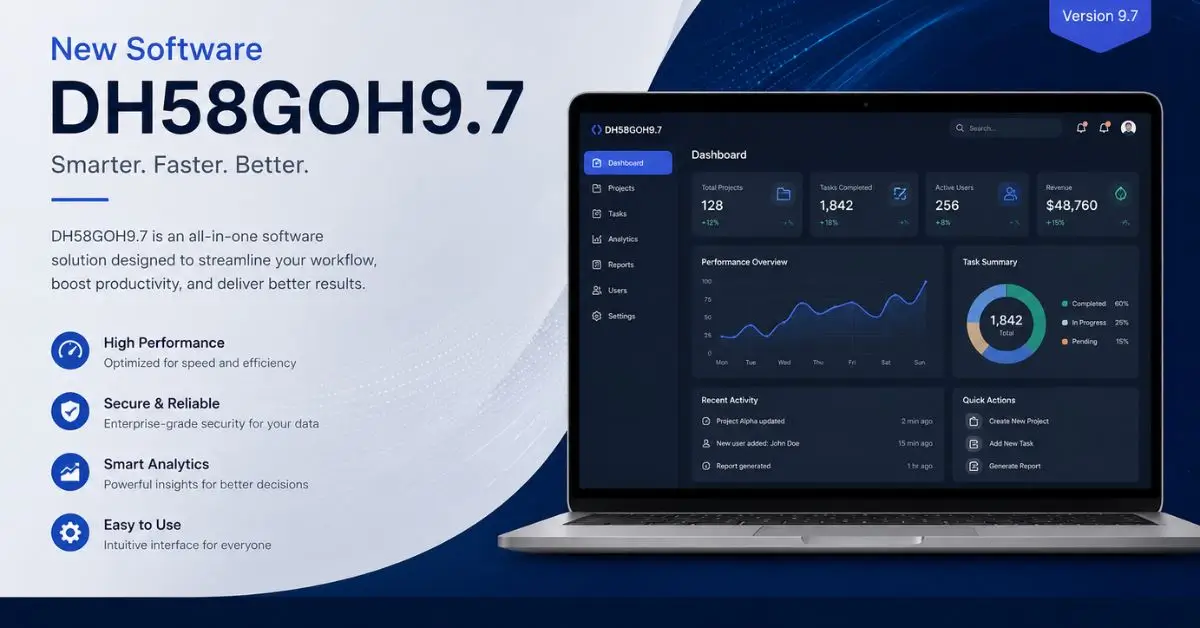
Every significant software release raises the same set of practical questions. What actually changed? Is this update worth adopting? Does it break anything that currently works? And what do I need to know before I install it or recommend it to others?
New software dh58goh9.7 is a specific version release that users are searching to understand before making adoption decisions. Whether you encountered it in a product update notification, a vendor communication, a technical specification document, or a colleague’s recommendation, getting a clear picture of what this version is and what it changes matters before you act on it.
This guide covers what the software and this specific version offer, how to interpret the version identifier, what typically changes at this release level, and how to evaluate whether adopting it makes sense for your specific situation.
New software dh58goh9.7 refers to a specific version release within the dh58goh9 software product line. The version identifier follows a standard alphanumeric format where the prefix identifies the product series and the decimal suffix indicates the specific point release within that series. This version represents an update from previous releases in the same family, introducing changes that may include new features, performance improvements, bug fixes, security patches, or compatibility updates depending on the software’s development focus.
New software dh58goh9.7 is a specific software version release that users need to understand before installing or adopting. This guide covers how to interpret the version number, what this type of release typically contains, how to evaluate whether it is appropriate for your system, and what questions to ask before updating. For specific feature details, consult the official release documentation for your platform.
Software version numbers carry more information than most users realize, and understanding what the dh58goh9.7 identifier communicates helps you interpret what kind of release this is before you read a single feature description.
The prefix: dh58goh9
The alphanumeric prefix identifies the product family or series. This prefix distinguishes this software line from others and, in combination with the version number, uniquely identifies the specific build. If you are evaluating whether new software dh58goh9.7 is relevant to your system, this prefix confirms which product series you are dealing with.
The decimal: .7
The .7 designation indicates this is the seventh point release within the dh58goh9 major version. Point releases in software development typically introduce a mix of the following: targeted bug fixes addressing issues identified after the major version launch, security patches closing vulnerabilities discovered in earlier point releases, minor feature additions or refinements that do not justify a major version increment, and performance optimizations based on real-world usage data gathered from previous releases.
The .7 position within a release series is significant. It suggests a version that has benefited from several previous iterations of improvement and bug fixing within the same major release cycle. By the seventh point release, most critical bugs from the initial major version launch have typically been identified and addressed, making .7 releases generally more stable than early point releases like .1 or .2.
This stability factor matters when evaluating whether to adopt the update, particularly in production environments where stability is more important than access to the newest features.
Understanding what point releases at the .7 level typically contain helps you set appropriate expectations and know what to look for in the official release notes.
Bug fixes from reported issues
By the seventh point release, a substantial backlog of user-reported issues from the major version launch and earlier point releases has accumulated. Version .7 typically addresses a significant portion of these known issues, particularly those affecting the largest user segments or causing the most critical functional problems.
When reviewing the release notes for this version, the bug fix section will tell you specifically which reported issues were resolved. If bugs you have personally encountered in earlier versions appear on this list, that is a strong reason to adopt the update.
Security vulnerability patches
Security patches are among the most important components of any point release. If vulnerabilities were discovered in dh58goh9 versions prior to .7, those patches are included here. For any software that processes sensitive data, handles user authentication, connects to external networks, or operates in a security-sensitive environment, security patches alone often justify updating.
Check the security advisories published alongside the release notes to understand which specific vulnerabilities were addressed, what their severity ratings are, and whether your current deployment is actively vulnerable to any of them.
Performance improvements
Real-world usage data collected from deployed versions often reveals performance bottlenecks that were not apparent during development and testing. Point releases frequently include targeted optimizations for the specific operations that proved slower than expected in production environments.
For users who have experienced performance issues with earlier versions of dh58goh9, the release notes for version .7 should specify which operations were optimized and what performance improvements were measured.
Compatibility updates
As the operating systems, browsers, databases, and third-party integrations that software depends on update their own versions, software releases need to maintain compatibility. Version .7 likely includes compatibility updates for recent versions of the environments it operates within.
If you have been unable to update a dependent system because the software was not yet compatible with the new version, checking whether version .7 addresses that compatibility gap is worthwhile.
| Aspect | Early Point Releases (.1-.3) | Mid Point Releases (.4-.6) | Later Point Releases (.7+) |
|---|---|---|---|
| Stability | Lower, initial issues common | Improving, major bugs addressed | Higher, cumulative fixes applied |
| Bug fix coverage | Limited to initial discoveries | Growing backlog addressed | Most known issues resolved |
| Recommended for production | Cautious adoption | Generally safe | Recommended adoption |
| Security patch coverage | Emerging | Improving | Most known vulnerabilities patched |
| Performance optimization | Minimal | Some | More comprehensive |
Not every software update is relevant to every user. Here is how to think about whether new software dh58goh9.7 is the right update for your situation.
Active users of earlier dh58goh9 versions
If you are currently running dh58goh9.1 through dh58goh9.6, upgrading to .7 is almost certainly worthwhile. You gain all the bug fixes, security patches, and improvements from the intervening releases as a cumulative update. The stability of a .7 release also makes this a lower-risk update than earlier point releases were at the time they were available.
Organizations evaluating new software adoption
If your organization has been considering adopting this software and has been waiting for a more stable version, a .7 release represents a reasonable entry point. The product has had time to mature within the current major version cycle, critical issues have typically been resolved, and the update cadence gives you a sense of how actively the software is maintained.
Users on older major versions
If you are running a significantly older major version of the software, updating to dh58goh9.7 involves not just the point release changes but everything that changed between your current major version and this one. This is a more significant decision that requires reviewing the major version release notes alongside the point release notes and testing more extensively before production deployment.
Development and testing environments
Technical teams evaluating this version for eventual production deployment benefit from installing it in a controlled test environment first. This allows verification that existing workflows, integrations, and customizations continue to function correctly before the update affects production systems.
Whether you are an individual user or a technical administrator responsible for a larger deployment, these evaluation steps apply before installing any significant software update.
Read the release notes completely
Release notes for software updates are not marketing documents. They are technical records of exactly what changed. Reading them completely takes time but prevents surprises after installation. Pay particular attention to any notes marked as breaking changes, deprecated features, or behavioral differences from previous versions.
Check system requirements
New software versions sometimes update their system requirements. Before installing dh58goh9.7, verify that your operating system version, available memory, disk space, and any dependent software versions all meet the requirements for this release.
Back up your current installation
Before installing any software update on a production system, creating a backup of your current installation and data allows you to restore the previous state if the update causes unexpected problems. This step should be non-negotiable for any system where downtime or data loss would be consequential.
Test in a non-production environment
For any system that is critical to your work or your organization’s operations, testing the update in a development or staging environment before production deployment is the professionally responsible approach. This is how you discover compatibility issues before they affect real operations.
Check community and support resources
Before installing any new software release, checking user forums, community discussions, and support channels for reports from early adopters gives you real-world information about any problems the official release notes may not have captured yet.
Even well-prepared software updates occasionally produce unexpected results in specific configurations. Here is a systematic approach to post-update problem handling.
Document the specific problem precisely
Before attempting any fix, document exactly what is happening. The specific error messages, the steps that reproduce the problem, the frequency of occurrence, and the conditions under which it does and does not appear. This documentation makes effective support requests and self-troubleshooting possible.
Check if others have the same issue
Search the software’s official support forums and community spaces for reports of the same problem. A problem that others are experiencing is more likely to be a known issue with a documented workaround or an upcoming patch fix than one that is unique to your configuration.
Contact official support with your documentation
If the problem is not already documented in community resources, submit a support request with the complete documentation you prepared. Include your version information, system configuration, the specific steps to reproduce the problem, and what you have already tried.
Maintain the ability to roll back
This is why the backup step before updating matters. If the update produces problems that cannot be quickly resolved and that materially affect your ability to work, having a clean restore path to the previous version is your most reliable fallback.
New software dh58goh9.7 represents a mature point release within its version family that brings accumulated improvements from earlier iterations in the same cycle. For users already running earlier dh58goh9 versions, the security and stability improvements at this point release level make adoption worthwhile in most cases. For organizations evaluating fresh adoption, the relative stability of a .7 release makes this a reasonable entry point.
The key is making the adoption decision based on your specific situation, the release notes relevant to your deployment, and a tested upgrade path rather than assumptions. Software updates at this level are almost always manageable with proper preparation.
If this guide helped you understand how to evaluate this update, explore our related articles on how to read software release notes effectively and building a safe software update process for your organization. Both give you the practical framework for managing software updates confidently going forward.
It is the seventh point release in the dh58goh9 software series, typically including accumulated bug fixes, security patches, performance improvements, and compatibility updates from the current major version cycle.
Generally yes. A seventh point release is more stable than early releases in the same cycle. Most critical bugs are resolved by this stage. Always check the release notes and known issues before deploying to production.
Check if any security vulnerabilities patched in this version affect your current setup. Review the bug fix list for issues you have experienced. If you are on an earlier dh58goh9 version, updating is generally recommended.
Check the developer’s official website, support portal, or changelog page. The release notes are the authoritative source for exactly what changed in this specific version.
Back up your current installation, verify system requirements, read the release notes fully, and test in a non-production environment if the system is critical to your operations.
It depends on the software. Check the installation documentation for the recommended upgrade path from your current version.