
 By James Anderson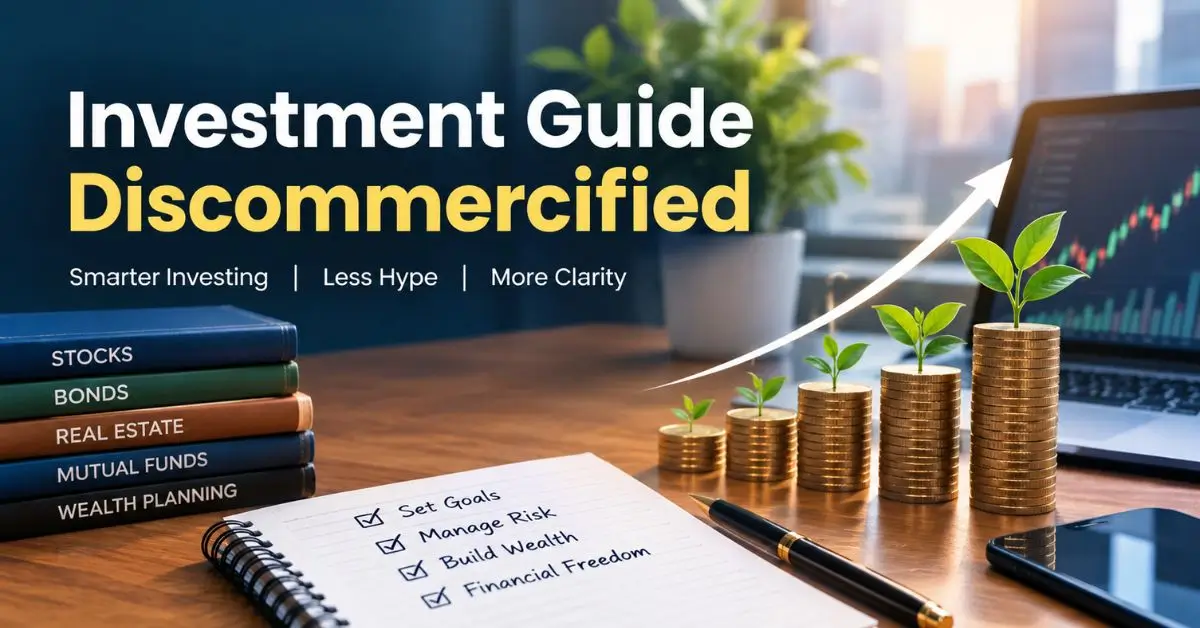
Managing your personal finances in the modern world can feel exhausting. Everywhere you look, financial television channels, social media influencers, and brokerage ads push volatile assets, day trading apps, and complex funds with high fees. Most everyday workers feel overwhelmed by the sheer volume of competing advice.
Chasing financial trends often results in heavy losses and constant stress. Following a grounded investment guide discommercified gives you a reliable framework to grow your savings safely. You do not need complicated trading algorithms or expensive financial advisors to build lasting security for your family.
An investment guide discommercified is a strategic financial framework focused on direct asset ownership, low-cost indexing, and tangible wealth preservation rather than commercial financial products. It teaches everyday investors how to eliminate broker fees, avoid market speculation, and build durable long-term portfolios using cash-flowing real estate, productive businesses, and transparent index funds.
Discommercified investing strips away the sales hype, high commissions, and frantic trading of the retail finance industry. Build your portfolio around broad, low-cost index funds, cash-flowing physical real estate, private business equity, and safe cash reserves. Using this investment guide discommercified will protect your capital, reduce your taxes, and give you true peace of mind.
The modern commercial investment industry is built to generate fees for financial institutions. Brokerages make money when you trade frequently. Mutual funds take a cut of your assets whether they make a profit or not. Financial media companies generate revenue by creating panic and excitement that keeps you glued to your screen.
A discommercified approach rejects this entire model. It treats capital growth like planting an oak tree. You choose good soil, plant high-quality seeds, provide water, and allow time to do the work. You do not dig up the tree every morning to see if the roots are growing.
When you invest this way, you only buy things with intrinsic, measurable utility. You look for businesses that make real products, real estate that provides needed shelter, and government securities backed by real economic output.
By studying this investment guide discommercified, you learn to step away from daily market drama. You focus entirely on building durable assets that generate cash flow regardless of which political party is in power or what the stock market does this week.
Most traditional financial advisors recommend complex products like variable annuities, whole life insurance policies, or actively managed mutual funds. While these products sound sophisticated, they often serve the person selling them far more than the person buying them.
A standard wealth management fee of 1.5 percent might sound tiny on paper. However, over a thirty-year career, that single fee can take away up to 40 percent of your final portfolio value. You take 100 percent of the financial risk while the management firm takes a huge portion of your returns.
Dozens of independent financial studies show that over 90 percent of professional fund managers fail to beat a simple, unmanaged market index over a fifteen-year period. If professional investors with supercomputers cannot outsmart the market consistently, individual investors trying to time stock charts will usually lose money.
Checking stock prices every hour causes chronic stress. It leads to buying high during euphoria and selling low during market corrections. A calm investment strategy removes emotion by relying on clear rules and automated processes.
Using the strategies in this investment guide discommercified helps you avoid these common traps and keep your hard-earned wealth working for you.
A resilient portfolio does not require hundreds of different stocks. It requires balance across four proven asset classes that behave differently in various economic conditions.
+---------------------------------------------------------------+
|             4 CORE PILLARS OF A RESILIENT PORTFOLIO           |
|                                                               |
|  1. Broad Low-Cost Index Funds (Global Equities)              |
|  2. Cash-Flowing Real Estate (Housing & Land)                 |
|  3. Direct Business Equity (Local & Private Enterprise)       |
|  4. Capital Reserves (Short-Term Treasuries & Cash)           |
+---------------------------------------------------------------+Index funds own a tiny piece of hundreds or thousands of profitable companies at once. They charge almost nothing in fees, often less than 0.05 percent per year. By owning a total stock market fund, you capture the collective growth of the entire economy without betting on any single company.
Physical real estate provides rental income, tax depreciation benefits, and natural protection against inflation. When inflation drives up the cost of living, property values and rental rates generally rise along with it.
Investing directly in profitable local businesses gives you access to solid cash flow without stock market volatility. You can provide working capital loans to established contractors or purchase minority equity stakes in profitable local service companies.
Liquidity is your financial shield. Holding three to twelve months of living expenses in short-term US Treasury bills or high-yield savings accounts prevents you from ever being forced to sell your long-term assets during a market downturn.
Structuring your assets according to this investment guide discommercified ensures you are prepared for both economic booms and unexpected downturns.
To understand how this works in practice, let us look at Mark, a 38-year-old software project manager living in Charlotte, North Carolina.
For five years, Mark followed popular financial trends. He held accounts on three different trading apps, bought trendy tech stocks, and invested in speculative digital tokens. By early 2023, his $120,000 savings had dropped to $85,000, and he felt constant anxiety about his financial future.
Mark decided to restructure his money using a structured investment guide discommercified. He liquidated his speculative holdings and built a balanced four-part plan:
- $45,000 (53%): Invested in a total world stock market index fund with an expense ratio of 0.04 percent.
- $20,000 (23.5%): Allocated as equity alongside a trusted local business partner to purchase a rental duplex in an established neighborhood.
- $15,000 (17.5%): Kept in four-week US Treasury bills paying steady interest to serve as an emergency safety net.
- $5,000 (6%): Invested directly in a local commercial solar cooperative paying a fixed 6 percent annual return.
Today, Mark spends less than thirty minutes a month reviewing his finances. His rental property generates steady monthly cash, his index funds grow automatically through monthly payroll deductions, and his cash reserves protect him from personal emergencies.
This real-world Charlotte example demonstrates how moving away from commercialized noise creates financial stability and mental peace.
The table below shows how discommercified investing differs directly from typical retail financial products.
| Category | High-Fee Commercial Products | Discommercified Strategy |
|---|---|---|
| Primary Vehicles | Active mutual funds, variable annuities | Low-cost index funds, physical real estate |
| Typical Annual Fees | 1.00% to 2.50% plus hidden trading costs | 0.03% to 0.10% total expense ratios |
| Cash Flow Focus | Paper capital gains on screen | Direct monthly rents, dividends, and interest |
| Volatility Profile | High emotional swings and drawdowns | Balanced, cash-backed stability |
| Advisor Incentives | Earns commissions on product sales | Self-directed or flat-fee fiduciary advice |
| Time Required | Hours of daily news tracking | One hour of quarterly portfolio review |
Seeing these differences side by side makes it clear why adopting a simpler, transparent strategy protects your lifetime earnings.
Transforming your financial life does not happen overnight, but you can make rapid progress by following these four actionable steps.
Step 1: Conduct Fee Audit ---> Step 2: Clear High-Interest Debt ---> Step 3: Build Liquid Shield ---> Step 4: Automate WealthLog into every retirement account, 401(k), IRA, and taxable brokerage account you own. Look up the expense ratio for every single fund. If you are paying more than 0.20 percent for any broad stock or bond fund, switch to an equivalent low-cost index fund.
Carrying credit card balances or personal loans at 15 to 25 percent interest destroys your ability to build wealth. Paying off a 20 percent credit card balance gives you an immediate, guaranteed 20 percent return on your money. No investment fund in the world can match that risk-free return.
Before investing heavily in long-term assets, build an emergency fund that covers at least six months of baseline living expenses. Store this money in a high-yield savings account or a rolling ladder of short-term US Treasury bills.
Set up automatic transfers so a fixed percentage of every paycheck goes straight into your core index funds on payday. When you automate your contributions, you buy more shares when prices are low and fewer shares when prices are high without ever having to guess market timing.
Following this investment guide discommercified roadmap turns long-term wealth building into a quiet, automatic background process.
Every financial path has risks, and honest planning requires understanding what a discommercified approach cannot do.
This strategy will not double your money in thirty days. It is designed to produce steady, compound growth over ten, twenty, or thirty years. If you are looking for rapid speculation, this method will feel slow.
Real estate and private business deals cannot be converted into cash in five minutes. If you need cash quickly, you must rely on your Treasury reserves and liquid savings rather than selling real property during a market dip.
When you choose self-directed indexing and direct real asset ownership, you make the final decisions. You cannot blame a financial advisor if you make an unforced error. You must take the time to learn the basic rules of asset allocation and stick to them through market swings.
Being aware of these limits ensures you apply this investment guide discommercified with realistic expectations and steady discipline.
Once you build wealth, keeping it requires a specific set of rules. Keep these five principles in mind as your assets grow:
- Never Invest in What You Do Not Understand: If an investment cannot be explained in simple terms on a single sheet of paper, do not put your money into it.
- Keep Your Fixed Living Costs Modest: The easiest way to increase your investment rate is to keep housing, vehicles, and recurring subscriptions well below your total earnings.
- Rebalance Only Once Per Year: Do not touch your asset allocations every month. Review your portfolio once a year, and adjust your contributions to bring your target percentages back into balance.
- Protect Your Physical Health: Health problems are one of the leading causes of personal financial distress. Investing in good food, regular exercise, and adequate rest protects your earning power.
- Maintain Adequate Property and Liability Insurance: As your net worth grows, carry sufficient umbrella liability insurance and property coverage to protect your real assets from unexpected legal claims.
Applying these habits alongside your core investment guide discommercified guarantees that your financial foundation remains secure across every stage of life.
True financial freedom does not come from watching stock tickers all day or jumping on the latest internet investing trend. It comes from owning productive, resilient assets and letting compound growth work uninterrupted over time.
By adopting the principles laid out in this investment guide discommercified, you can take control of your financial future. Audit your current accounts, eliminate high management fees, build a reliable emergency cash shield, and automate your investments into broad index funds and productive real assets. Start taking these small, practical steps today to build wealth that gives you lasting security and freedom.
A discommercified investment strategy focuses on low-cost, long-term investing while minimizing unnecessary fees, financial products, and intermediaries.
Lower fees leave more money invested and allow compound growth to work over time. Even small annual fee differences can significantly affect long-term retirement savings.
Yes, beginners can use a simple plan based on low-cost index funds, automated contributions, and an emergency fund.
Tangible assets such as real estate can provide practical utility and potential income. They can also add diversification to a broader investment portfolio.
Most long-term investors can review their portfolio once or twice a year. Regular reviews can help with rebalancing and checking whether contributions still match their goals.