 By James Anderson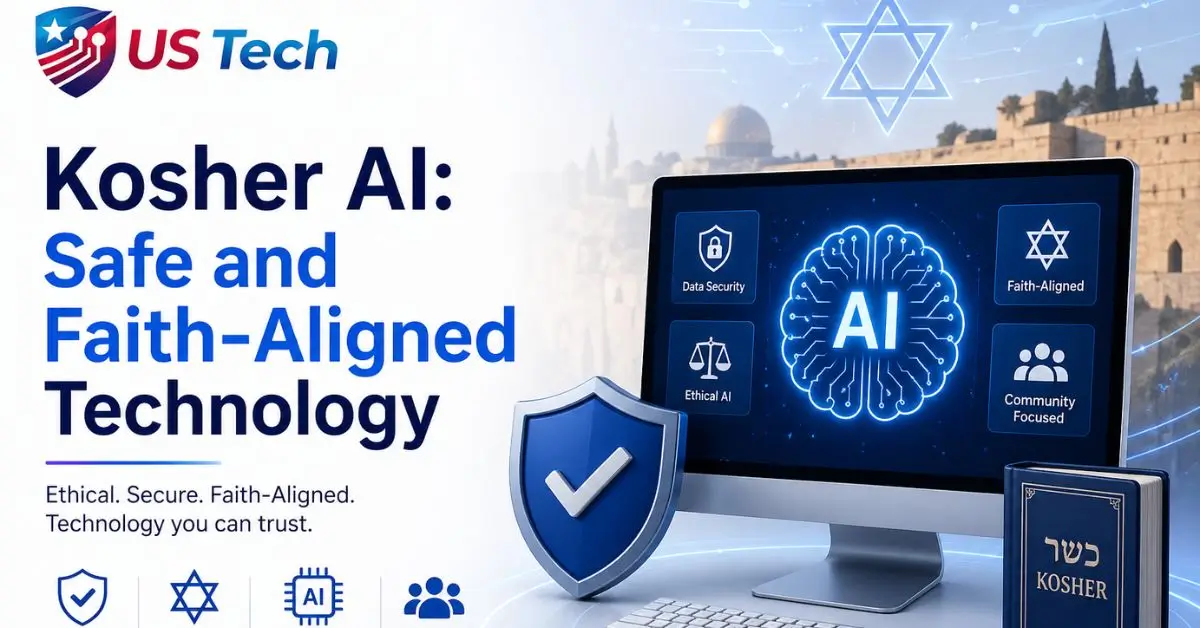
Artificial intelligence is everywhere now. It writes emails, generates images, answers questions, and even helps run businesses. But not everyone is comfortable with how open and unfiltered most AI tools are.
For observant Jewish communities and increasingly for other faith-based groups standard AI tools raise real concerns. Inappropriate content, answers that conflict with religious values, and unrestricted access to harmful material are genuine problems. That’s exactly where kosher AI steps in.
Kosher AI refers to artificial intelligence tools and platforms that have been designed or modified to align with Jewish religious standards and values. These tools filter content, restrict inappropriate outputs, and operate within guidelines approved by rabbinical authorities making AI usable for communities that need technology to respect their faith boundaries.
This guide explains what kosher AI actually is, how it works technically, who uses it, and what it means for the broader conversation about ethical AI.
Kosher AI describes AI tools built or adapted to meet Jewish religious standards. They filter harmful content, follow rabbinical guidelines, and provide a faith-safe digital experience. These tools are growing in the US and beyond, serving observant communities that want AI’s benefits without compromising their values. This guide covers everything you need to know clearly and honestly.
To understand why these tools exist, you need to understand the problem they solve.
Most mainstream AI platforms ChatGPT, Google Gemini, image generators are designed for general audiences. They don’t have built-in religious filters. Ask a standard AI tool a question, and it may generate content that includes inappropriate language, explicit imagery, or viewpoints that directly conflict with religious teachings.
For families and individuals in Orthodox and Ultra-Orthodox Jewish communities, this is a serious concern. These communities already use filtered internet services and modified smartphones. Extending those same principles to AI tools is a natural and necessary step.
It’s not about rejecting technology. It’s about using technology within boundaries that respect deeply held beliefs.
And this need isn’t hypothetical. In communities like Brooklyn’s Borough Park, Lakewood in New Jersey, and Monsey in New York, thousands of families actively seek technology solutions that fit their way of life. The demand for faith-aligned AI tools is real, specific, and growing.
The concept is straightforward, but the execution involves several layers.
At the core, these tools use advanced content filters that screen both inputs and outputs. If a user asks something that could lead to inappropriate content, the system either redirects the query, provides a filtered response, or blocks the output entirely.
This goes beyond simple keyword blocking. Modern filtered AI systems use contextual understanding to evaluate whether a response is appropriate not just whether it contains a flagged word.
What separates kosher AI from a regular “safe mode” is rabbinical supervision. These tools are reviewed and approved by recognized religious authorities who set the standards for what’s acceptable. This isn’t just a tech company deciding what to filter it’s a collaborative process between developers and religious leaders.
This oversight is similar to how kosher food certification works. A product isn’t just “probably fine” it carries an actual certification from a recognized authority.
Some faith-based AI platforms restrict entire categories of content. For example, they may block all image generation capabilities to prevent the creation of inappropriate visuals. Others may limit the AI’s ability to discuss certain topics altogether.
The level of restriction varies by platform and by the community’s specific standards.
Some developers go further by training their AI models on curated datasets. Instead of using the full, unfiltered internet as training data, they select sources that align with religious values. This affects not just what the AI says, but how it thinks about topics.
The primary audience is the observant Jewish community, but the user base is broader than you might expect.
Orthodox and Ultra-Orthodox families are the core users. Parents want AI tools their children can use safely for schoolwork and learning without worrying about exposure to inappropriate content.
Jewish schools and yeshivas use filtered AI tools to support education. Students can research, write, and learn with AI assistance within approved boundaries.
Jewish businesses that serve community needs from publishing to customer service use these tools to ensure their operations stay aligned with community standards.
Other faith-based communities are watching this space closely. Christian, Muslim, and other religious groups face similar concerns about unfiltered AI, and the kosher AI model is becoming a template for broader faith-based technology solutions.
| Feature | Standard AI Tools | Kosher AI Tools |
|---|---|---|
| Content filtering | Basic or optional safe modes | Multi-layered, rabbinically approved |
| Religious oversight | None | Active rabbinical supervision |
| Image generation | Unrestricted | Often restricted or disabled |
| Training data | Full internet | Curated, value-aligned sources |
| Target audience | General public | Faith-observant communities |
| Customization | User-controlled settings | Community-standard settings |
| Availability | Widely available | Niche but growing |
Several platforms and initiatives are already serving this market in the US.
Communitech and similar organizations in the Orthodox tech space have been developing filtered technology products for years, starting with internet filters and smartphones, and now expanding into AI.
AI-powered Torah study tools are one of the most practical examples. These tools let users search, analyze, and study religious texts using AI while keeping the technology within approved guidelines. Imagine an AI that can cross-reference Talmudic passages instantly but won’t generate content outside its designated scope.
Customer service chatbots for community businesses are another growing use case. A kosher bookstore or catering service can use an AI chatbot that handles customer questions efficiently without any risk of the bot producing off-brand or inappropriate responses.
In Lakewood, New Jersey home to one of the largest Orthodox communities in the US tech companies are actively building and marketing filtered AI solutions tailored to local needs. This isn’t a theoretical market. It’s an active, funded, growing industry.
Here’s why this topic matters beyond any single religious community.
The conversation around this AI connects directly to the larger global debate about AI alignment the effort to make artificial intelligence behave in ways that match human values.
Every time someone builds a filtered, value-aligned AI tool, they’re answering a version of the same question the entire tech industry is asking: How do we make AI safe and appropriate for specific audiences?
The kosher AI approach offers a working model. It proves that AI can be customized to serve specific value systems without losing its usefulness. That’s a lesson that applies to:
- Children’s AI tools
- Workplace-appropriate AI
- AI for sensitive industries like healthcare and education
- Cultural and regional AI customization
In a sense, these faith-aligned tools are ahead of the curve on a problem the mainstream tech world is still trying to solve.
No technology is perfect, and filtered AI tools have real trade-offs.
Reduced functionality is the most obvious one. When you restrict what an AI can do, you naturally limit its usefulness in some areas. Users of heavily filtered tools may find that certain queries return no results or overly cautious answers.
Smaller development teams mean slower updates. Mainstream AI tools have billions in funding. Niche faith-based alternatives operate with far smaller budgets, which can affect performance and feature development.
Over-filtering is a real risk. Sometimes, a legitimate educational or professional query gets blocked because the filter is too aggressive. Finding the right balance between safety and usability is an ongoing challenge.
Limited language model capabilities. Some filtered platforms use older or less powerful AI models to maintain tighter control over outputs. This can mean less accurate or less helpful responses compared to cutting-edge mainstream tools.
These limitations are worth knowing not to discourage use, but to set realistic expectations.
The trajectory is clear. As AI becomes more embedded in daily life, the demand for faith-aligned and value-aligned versions will keep growing.
We’re likely to see:
- More sophisticated filtering that reduces over-blocking
- Partnerships between major AI companies and religious certification bodies
- Expansion beyond Jewish communities into other faith groups
- Better-funded development as the market proves its viability
- Integration with existing filtered internet and phone ecosystems
The broader AI industry will also benefit. The techniques developed for religious content filtering can improve child safety tools, workplace AI compliance, and cultural sensitivity in AI systems worldwide.
Kosher AI represents something bigger than a niche product. It’s proof that artificial intelligence doesn’t have to be one-size-fits-all. Communities with specific values deserve technology that respects those values and developers are rising to meet that need.
Whether you’re part of an observant community, a parent looking for safer AI options, or simply interested in how technology adapts to serve diverse audiences, this is a space worth following closely.
Explore more guides on US Tech to stay informed about how AI is evolving and what it means for your world.
AI tools built to meet Jewish religious standards filtered, rabbinically approved, and community-safe. Think kosher food certification, but for technology.
No. Other faith groups, parents, and organizations needing controlled AI outputs all use these tools. The filtering principles work beyond one religion.
Safe mode is a basic setting. Kosher AI is built differently from the ground up with rabbinical oversight, curated data, and community-specific restrictions already built in.
Yes. Businesses use it for customer service, email drafting, and content creation staying productive while keeping every output within approved standards.