
 By James Anderson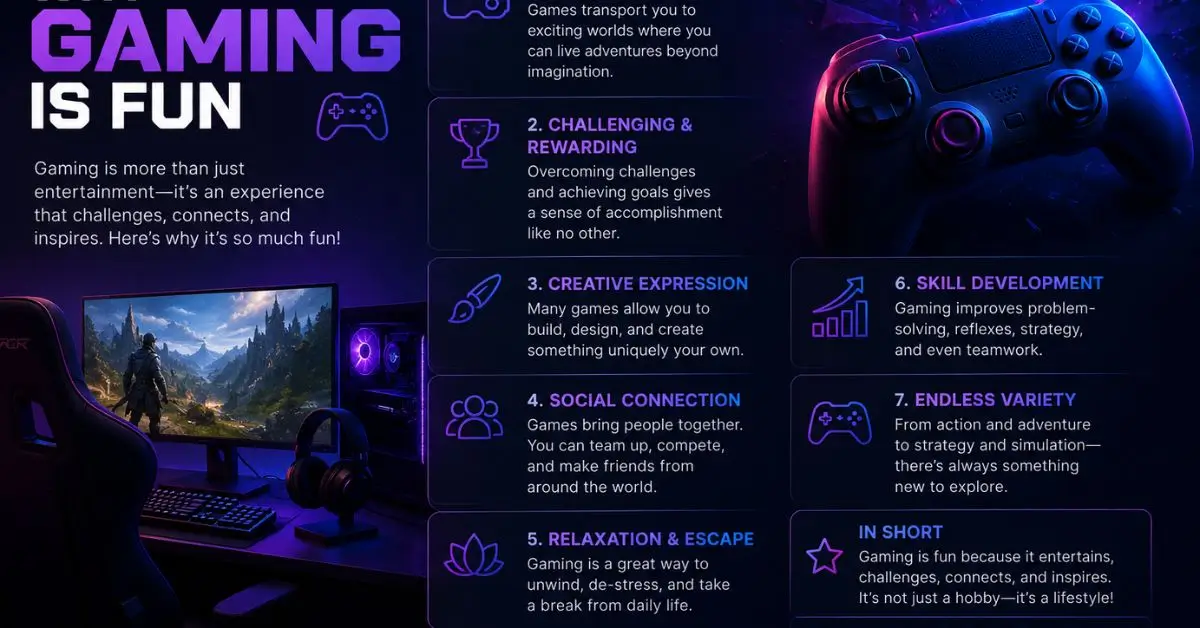
Most people who play games regularly do not spend much time asking why they find it fun. They just know they do. But the question matters more than it might seem, especially when you are trying to explain gaming to someone who does not get it, when you want to understand your own hobby more deeply, or when you want to make better choices about how you spend your gaming time.
The bfnctutorials approach to this question goes deeper than listing entertainment value and stopping there. Gaming is genuinely fun for reasons rooted in psychology, human connection, creative expression, and the specific way interactive experiences engage us differently from passive media. Understanding these reasons transforms how you think about games and why they occupy the space they do in so many people’s lives.
This guide covers the real reasons why gaming is fun, organized by the actual mechanisms that produce enjoyment, with honest context about what makes the experience genuinely valuable.
Why gaming is fun bfnctutorials refers to the genuine psychological, social, and experiential explanations for why interactive gaming produces authentic enjoyment and engagement. Beyond simple entertainment, gaming delivers challenge, achievement, social connection, creative expression, narrative immersion, and skill development in combinations that most other leisure activities cannot replicate. Understanding these mechanisms explains why gaming resonates so deeply with so many people across different ages, backgrounds, and cultures.
Gaming is genuinely fun because it delivers challenge, achievement, social connection, creative freedom, and narrative immersion in interactive ways that passive entertainment cannot match. The bfnctutorials perspective on why gaming is fun goes beyond surface enjoyment to explain the psychological mechanisms that make games so engaging and why that engagement is legitimate and meaningful.
Before getting into specific reasons, understanding why interactive experiences produce a qualitatively different kind of enjoyment than passive ones matters.
When you watch a film, you observe a story. When you play a game, you participate in one. Your decisions affect outcomes. Your skill determines results. Your choices shape what happens next. This shift from observer to participant changes the entire emotional relationship with the experience.
Psychologists call this the sense of agency, the feeling that your actions matter and produce real effects. Gaming delivers agency at a level that very few other activities do, and that sense of mattering is a core component of what makes the experience feel engaging rather than merely entertaining.
This is why gaming is fun at a level that people who have never played seriously often struggle to understand from the outside. They are picturing a passive viewing experience with a controller. What they are missing is the fundamentally different psychological engagement that agency creates.
One of the most consistent reasons why gaming is genuinely rewarding is the challenge-to-skill relationship that good game design creates.
Games present you with problems. You fail. You learn. You try again with better understanding. You succeed. This cycle produces a specific type of satisfaction that psychologists associate with genuine achievement, distinct from the hollow satisfaction of activities that offer no real resistance.
The moment when something that was impossible becomes possible, when you finally clear a boss you have been stuck on for hours, or when a mechanical skill that felt impossibly fast becomes natural with practice, produces a satisfaction that is genuinely earned. It is not handed to you. It required persistence, learning, and improvement.
The bfnctutorials community recognizes this as one of the core reasons why gaming resonates beyond simple entertainment. The challenge is not an obstacle to the fun. The challenge is the fun. People who understand this about gaming approach it very differently from those who do not.
Most well-designed games include explicit progress systems that make improvement visible. Experience points, level progression, unlockable content, achievement systems, and skill trees all provide continuous feedback about advancement.
This feedback loop taps into something fundamental about how humans experience motivation. Progress feels good in a measurable, visible way that extends beyond the individual moment. A character that is significantly stronger than it was ten hours ago represents a visible record of the time and effort invested.
For players who enjoy seeing this kind of progress, games provide a uniquely clear relationship between input and output. Put in the time and effort, and the progress is real and visible. This is not always true in other areas of life, which makes games’ clear progress systems particularly satisfying to many players.
Gaming is often portrayed as a solitary activity, and while solitary gaming is genuinely enjoyable and valid, the social dimension of gaming is one of the most significant reasons so many people find it compelling.
Multiplayer gaming creates shared experiences that form the basis for genuine friendships and community relationships. Working through a difficult cooperative challenge with friends, competing in ways that are intense but ultimately low-stakes, communicating strategy and reacting together to unexpected developments, these are genuine social experiences that gaming creates in ways that other activities cannot replicate exactly.
The gaming community around platforms like bfnctutorials demonstrates this. Communities form around shared games, shared challenges, and shared passion for interactive experiences. For many people, gaming is the primary context in which they maintain meaningful social connections, whether with childhood friends who have moved apart or with new people met through online communities.
A teenager in Austin who plays online games with friends from different states throughout high school is having genuinely meaningful social experiences through gaming. The medium does not diminish the authenticity of the connection.
Many games offer significant creative freedom. Building structures in Minecraft, designing characters in role-playing games, developing play styles in competitive games, creating content in sandbox environments, these are genuine acts of creative expression that gaming uniquely enables.
Why gaming is fun for creatively oriented players often comes down specifically to this dimension. Games provide a sandbox for expression and experimentation where the consequences of choices are low stakes but the creative satisfaction is real. You can build something that did not exist before and see it rendered in an interactive environment that responds to what you created.
Even in games that do not emphasize explicit creation, players develop personalized approaches, strategies, and play styles that represent a form of creative identity within the game world. The way you play a game becomes an expression of who you are as a player.
| Reason Gaming Is Fun | Primary Mechanism | Game Types That Deliver It Best |
|---|---|---|
| Challenge and mastery | Achievement satisfaction | Platformers, action RPGs, fighting games |
| Social connection | Community and shared experience | Multiplayer, co-op, MMOs |
| Creative expression | Player agency and creation | Sandbox, RPGs, strategy games |
| Narrative immersion | Emotional engagement with story | Story-driven RPGs, adventure games |
| Progress systems | Visible achievement feedback | RPGs, looter shooters, progression games |
| Competitive recognition | Skill testing and social status | FPS, fighting games, MOBAs |
| Mental restoration | Structured escapism | Casual, open-world, relaxing games |
Modern games tell stories with emotional depth, character development, and narrative complexity that rivals the best films and novels. The interactive dimension adds a layer of investment that passive storytelling cannot match.
When you make a difficult choice for a character in a game, when you lose a companion you cared about, when you reach the conclusion of a story arc you have been part of for forty hours, the emotional response is real and legitimate. The fact that it happened in a game does not make the feeling less genuine.
This narrative dimension is why gaming is fun for players who are drawn to stories and emotional experiences. The bfnctutorials community often discusses how specific game narratives have stayed with players long after finishing them, in the same way great books and films do, but with an additional layer of personal connection because you were the one who made the choices.
Gaming provides a form of structured escapism that serves a genuine psychological function for many players. Entering an engaging game world creates a context switch that allows mental recovery from the demands of work, study, and daily responsibilities.
This is not avoidance in a negative sense. It is the same mechanism that makes other leisure activities, reading, watching films, outdoor activities, restorative. The difference is that gaming’s interactive engagement tends to fully occupy the mind in ways that passive activities sometimes do not, making it particularly effective as a mental break from stressful or cognitively demanding daily experiences.
Understanding this mechanism helps players use gaming intentionally as part of a balanced life rather than guiltily or apologetically. Gaming as a restorative leisure activity is legitimate, the same way all effective leisure is legitimate.
For players drawn to competition, gaming offers a structured environment where skill is genuinely tested and recognized. Leaderboards, ranked modes, tournament structures, and competitive communities provide a context where improvement is meaningful and achievement carries genuine social recognition within the community.
The competitive dimension of why gaming is fun operates similarly to how competition functions in traditional sports. The drive to improve, to outperform opponents, and to achieve recognition for skill are fundamental human motivations that gaming channels effectively.
Understanding why gaming is fun reveals something important. The enjoyment is not arbitrary or superficial. It is rooted in genuine psychological mechanisms, the same ones that make meaningful work satisfying, that make sports engaging, that make creative expression rewarding.
The bfnctutorials perspective on gaming recognizes this depth. When you understand what makes games genuinely engaging, you can approach your gaming time more intentionally, choose games that deliver the specific experiences you find most valuable, and articulate why gaming matters to people who have not yet understood it.
If this guide helped you understand what makes gaming genuinely enjoyable, explore our related articles on how to find the right games for your play style and understanding different gaming genres and what makes each one unique. Both give you the practical context for getting more from your time with games.
It comes down to real psychological mechanisms including overcoming challenges, social connection through multiplayer, creative freedom, narrative immersion, visible progress systems, and the genuine mental restoration gaming provides as engaging leisure.
Yes. Gaming delivers challenge, creativity, social connection, and storytelling in ways that are genuinely valuable. The enjoyment, the skills developed, and the communities built are all real and meaningful.
Because of agency. In games you are a participant, not just an observer. Your decisions affect outcomes and your skill shapes results, creating a deeper psychological connection than passive entertainment can.
Yes, in balanced amounts. It builds problem-solving, strategic thinking, coordination, and social skills. The benefits depend on how gaming fits into an overall balanced lifestyle.
Games feel best when challenge matches skill, creating a state of flow where you are fully engaged without being overwhelmed or bored. That balance is what separates truly enjoyable games from frustrating or dull ones.
For players driven by achievement and skill growth, gaming offers measurable progress and clear feedback that many other leisure activities do not provide as explicitly or consistently.